The Cleaning

The
Cleaning

Paris, 1786
A young girl with flowers.
Imagined overpaint
Move the small frame.Or focus here and use the arrow keys.

A girl.
A basket.
Flowers.

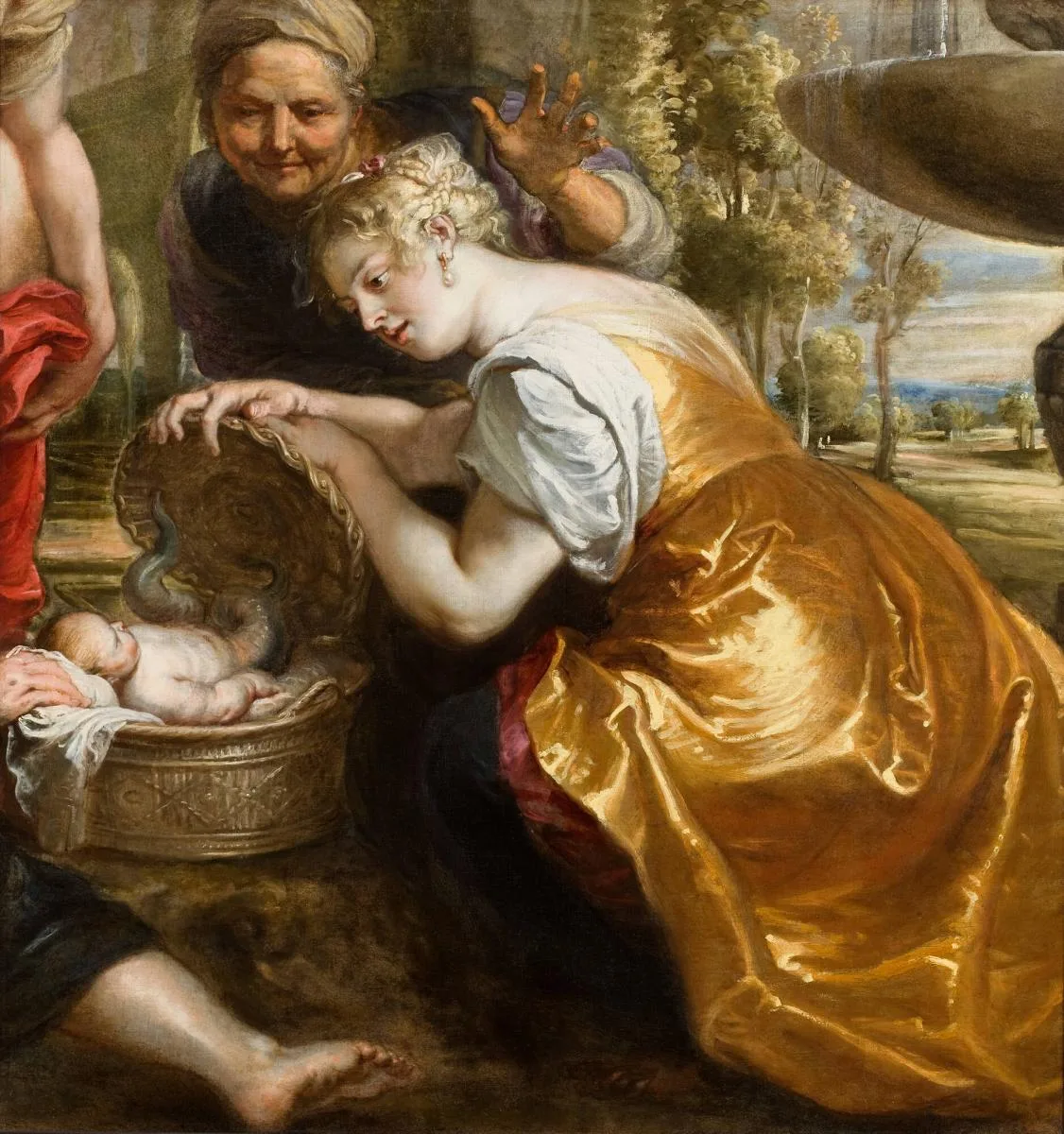
That was the picture offered for sale. Its edges had been cut away. Blossoms covered what she held.

Someone
remembered
another picture.

Ludwig Burchard recognized the composition from a print after Rubens. He suggested cleaning it.

A child.

The painting was keeping him, too.

Follow the child into Athena’s care ↗The painting’s recorded history

Move your hand across the flowers.

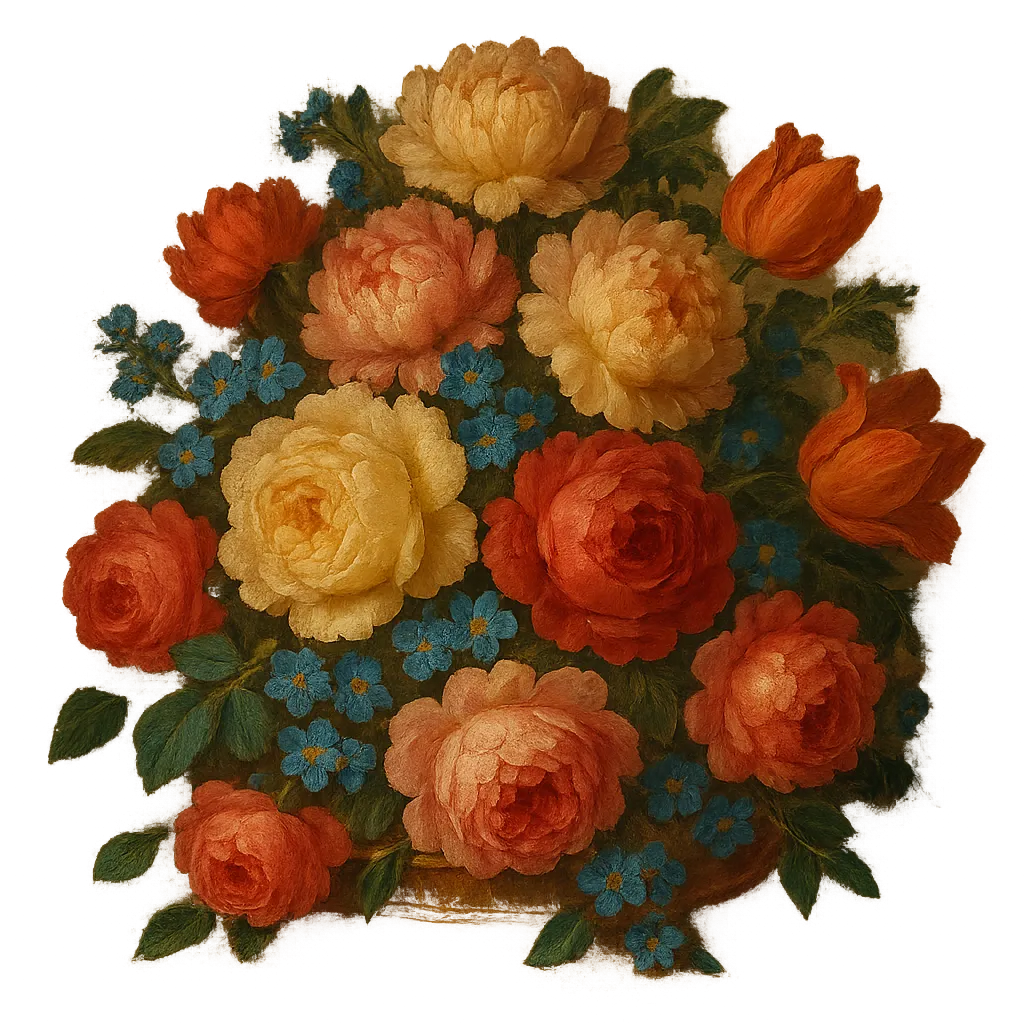
Imagined overpaint over the surviving Rubens

Her hand survived.

Most of her body did not.

Beyond the cut.

A body takes shape around the surviving hand.

Pandrosos.

The sister Pausanias calls faithful to what was entrusted.

Enter the company beyond the cut ↗Her surviving hand, in Oberlin’s catalogue

The surviving Rubens · fingers at the cut left edge
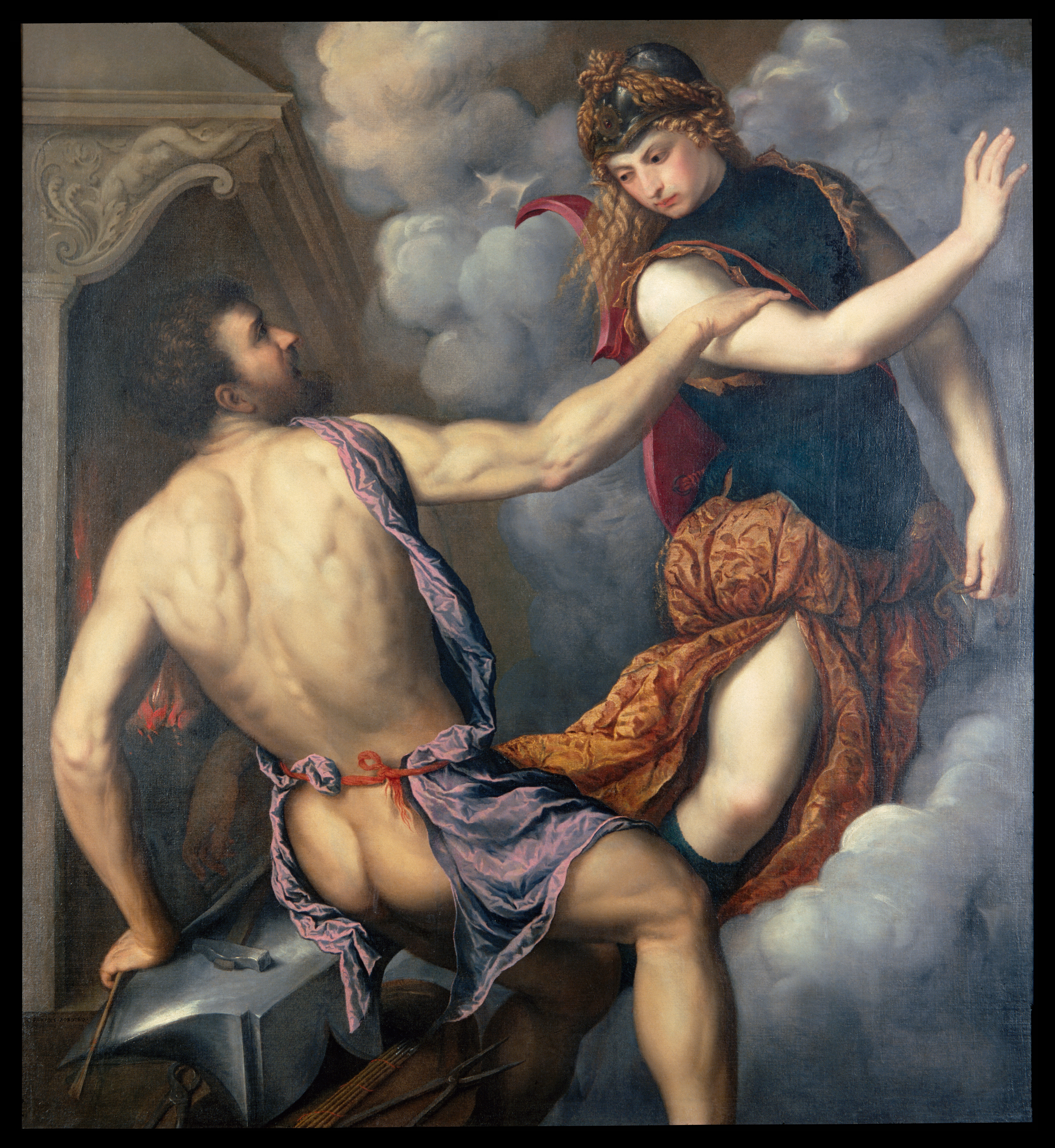
The complete painting, Athena Scorning the Advances of Hephaestus, by Paris Bordone, about 1555–60.
The hand lifting the basket lid in Rubens’s painting.

She wipes
it away.

Hephaestus tries to force himself on Athena. She resists. His semen falls on her leg; she wipes it off with wool and throws it to the ground.

The earth
bears the child.

Erichthonius is born from the ground. Rubens paints him with serpent legs. Athena takes the child into her care.

In secret.

She means to make him immortal.
She raises him unknown to the other gods.

Enter the moving clay ↗

Keep it
closed.

Athena places him in a covered vessel.
They must keep it without looking inside.

Aglauros
lifts the lid.

In the tradition Pausanias tells, Pandrosos alone keeps faith with the trust.

The differing ancient accounts

Paris Bordone, c. 1555–60 · Museum of Art and Archaeology, MissouriAn imagined Athena · the lid moves with your passage

Pandrosos.

Her hand, at the cut edge.
Pausanias · 1.27.2

Her sanctuary.

Beside Athena’s temple, the sister who kept faith with the trust.

The next passage · 1.27.3

Two girls.
A way below.

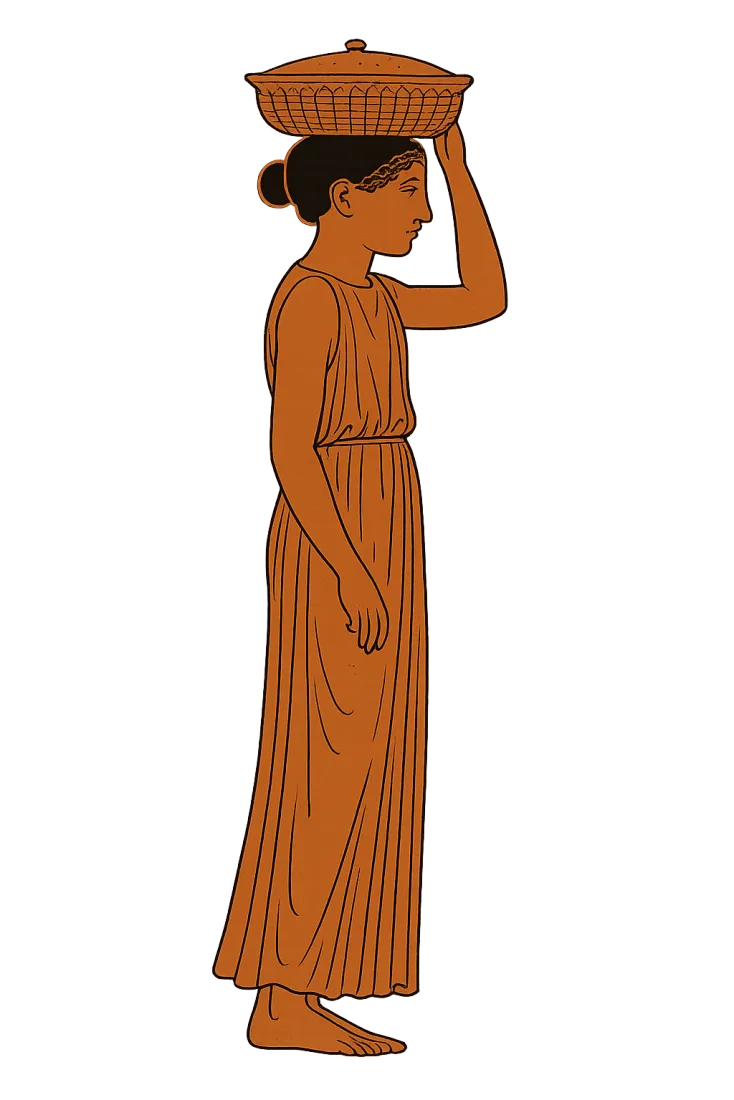
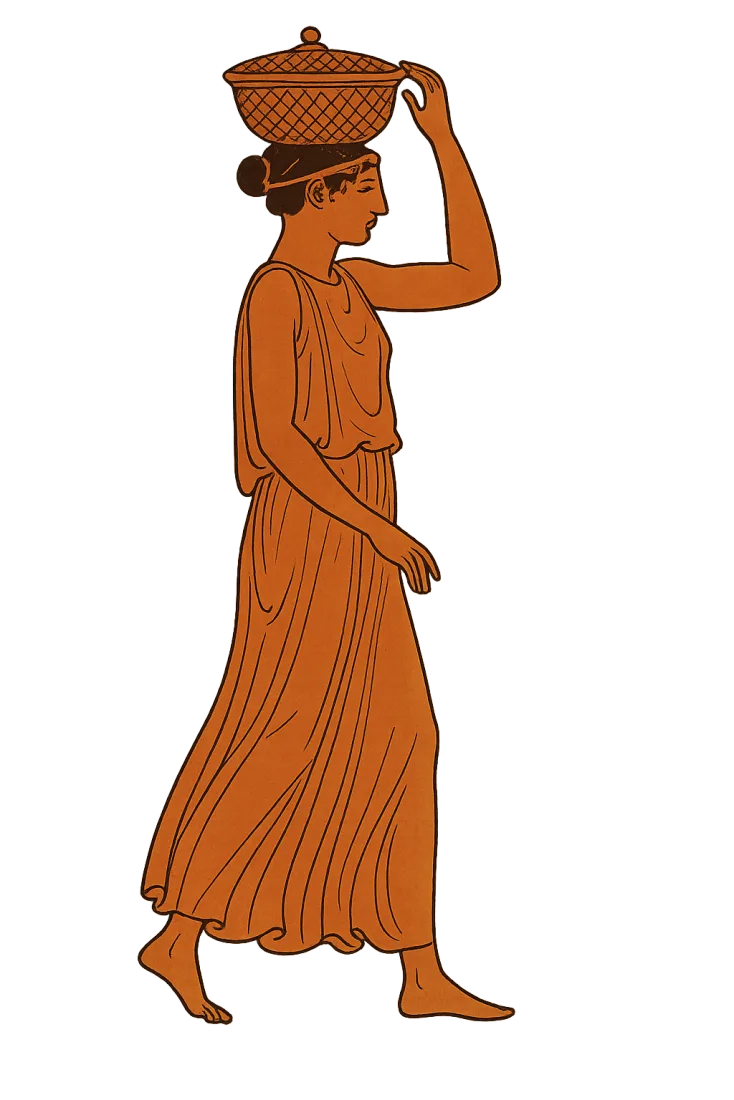
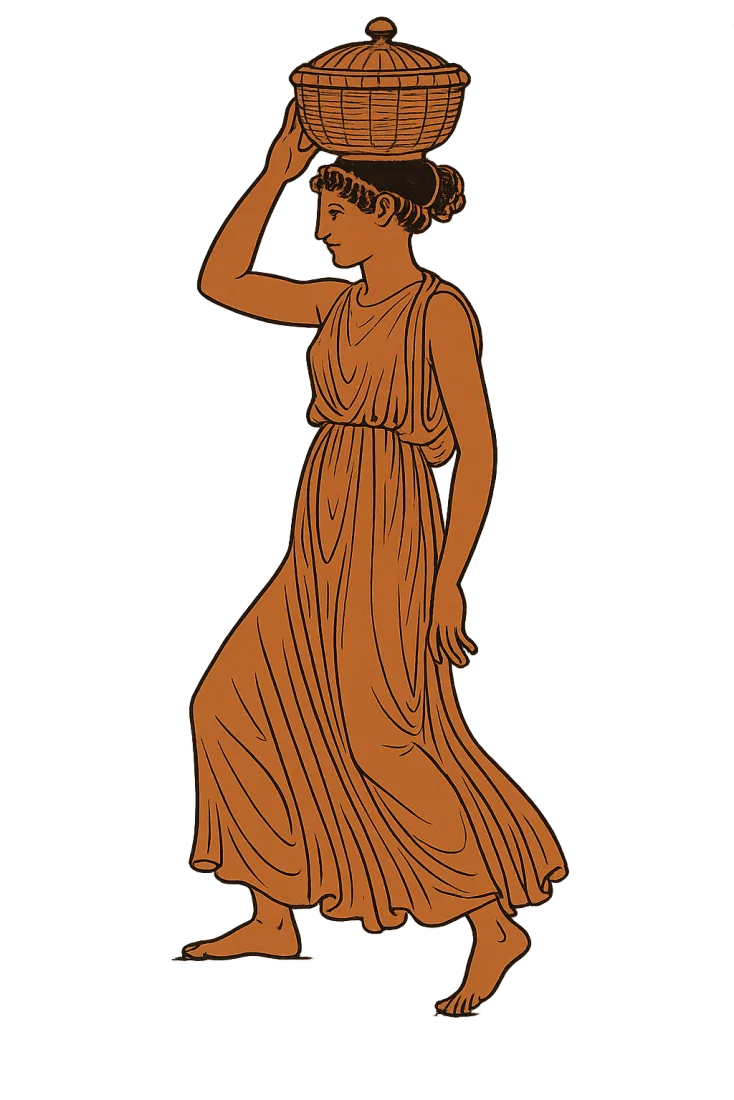
They carry unknown things below ground.
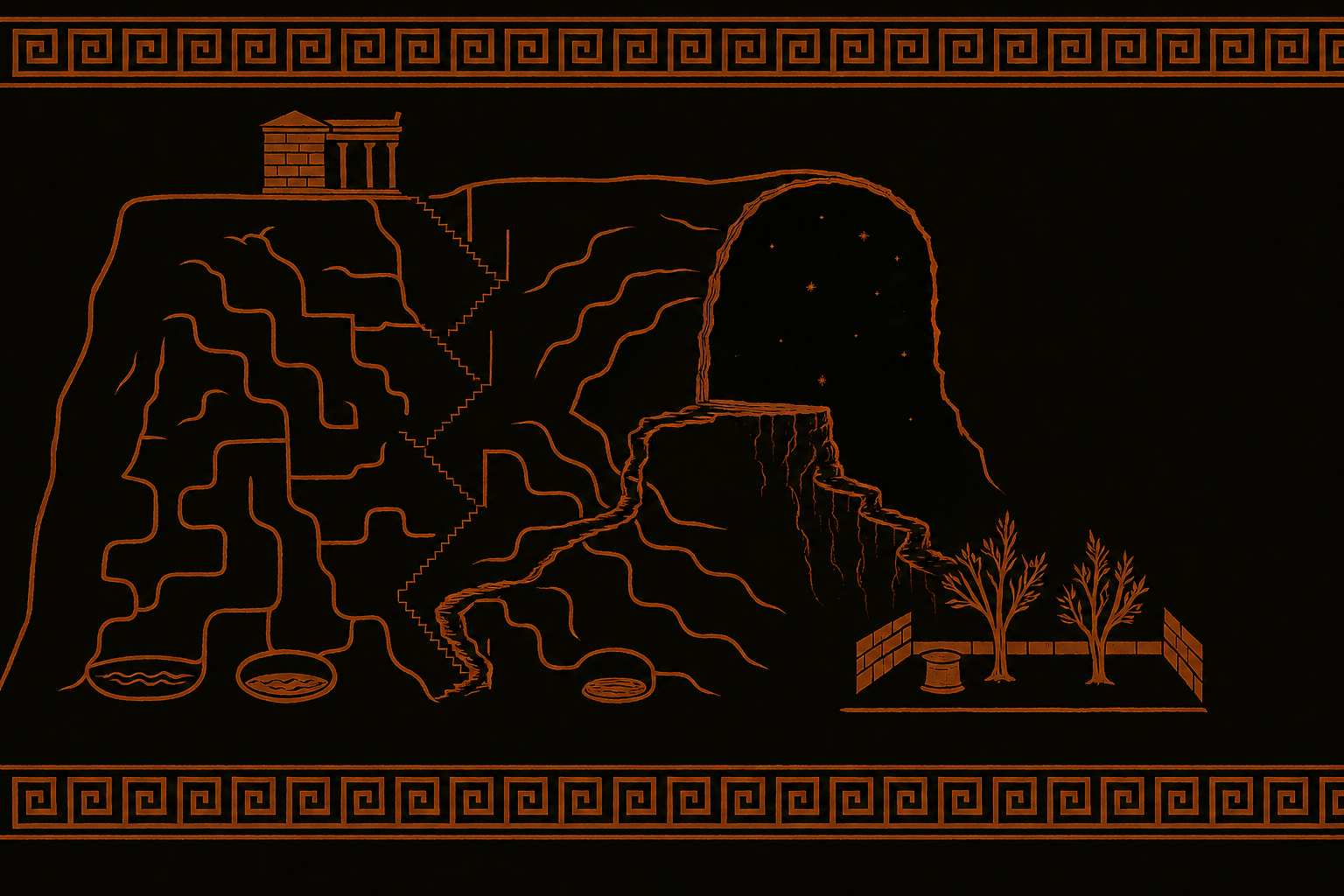
Pausanias 1.27.2–3 · read the two passages

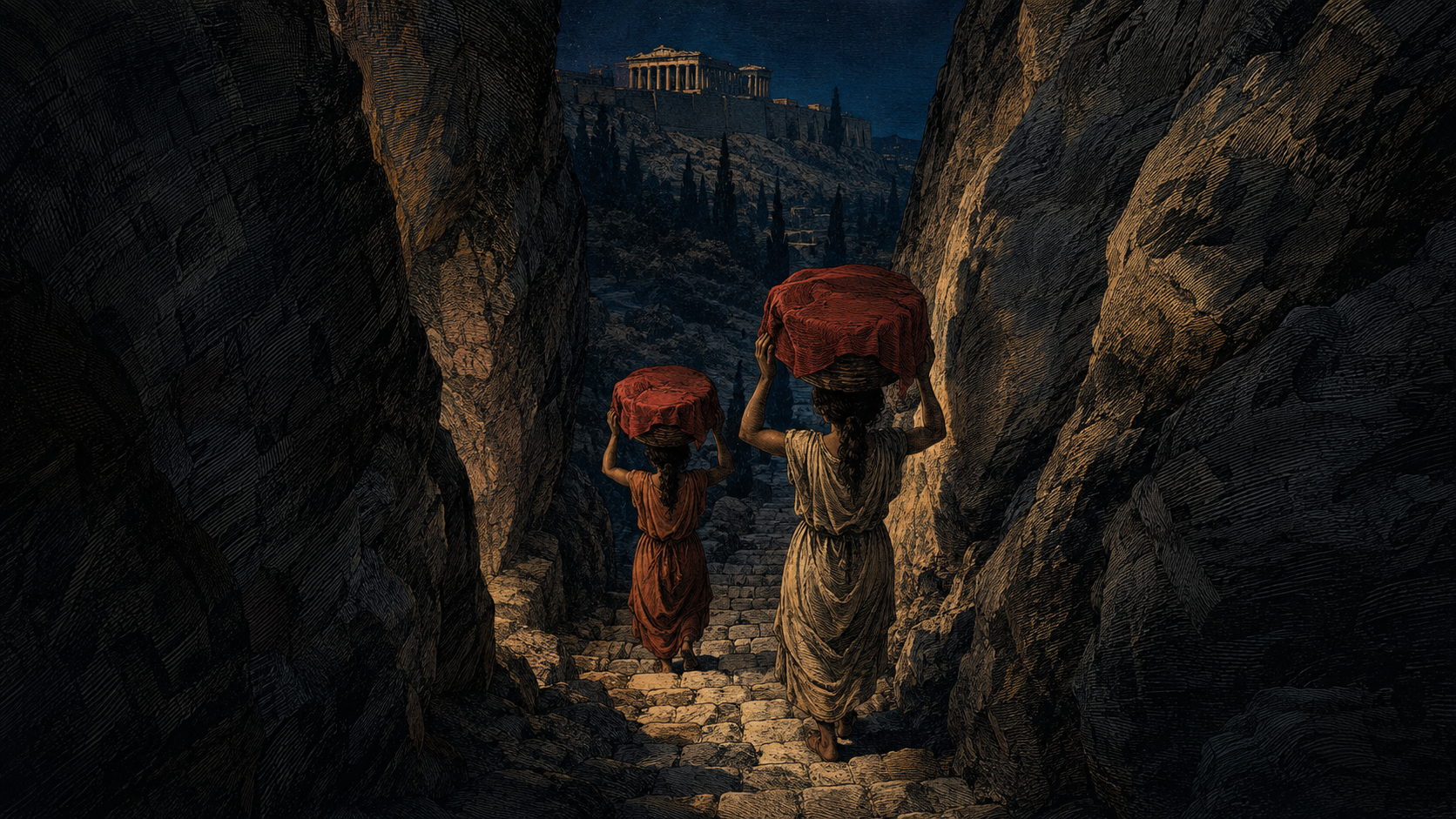
An imagined pottery landscape: a stair inside the Acropolis opens onto a narrow ledge above a garden.

For a time,
this is their home.

Two girls live near Athena’s temple.
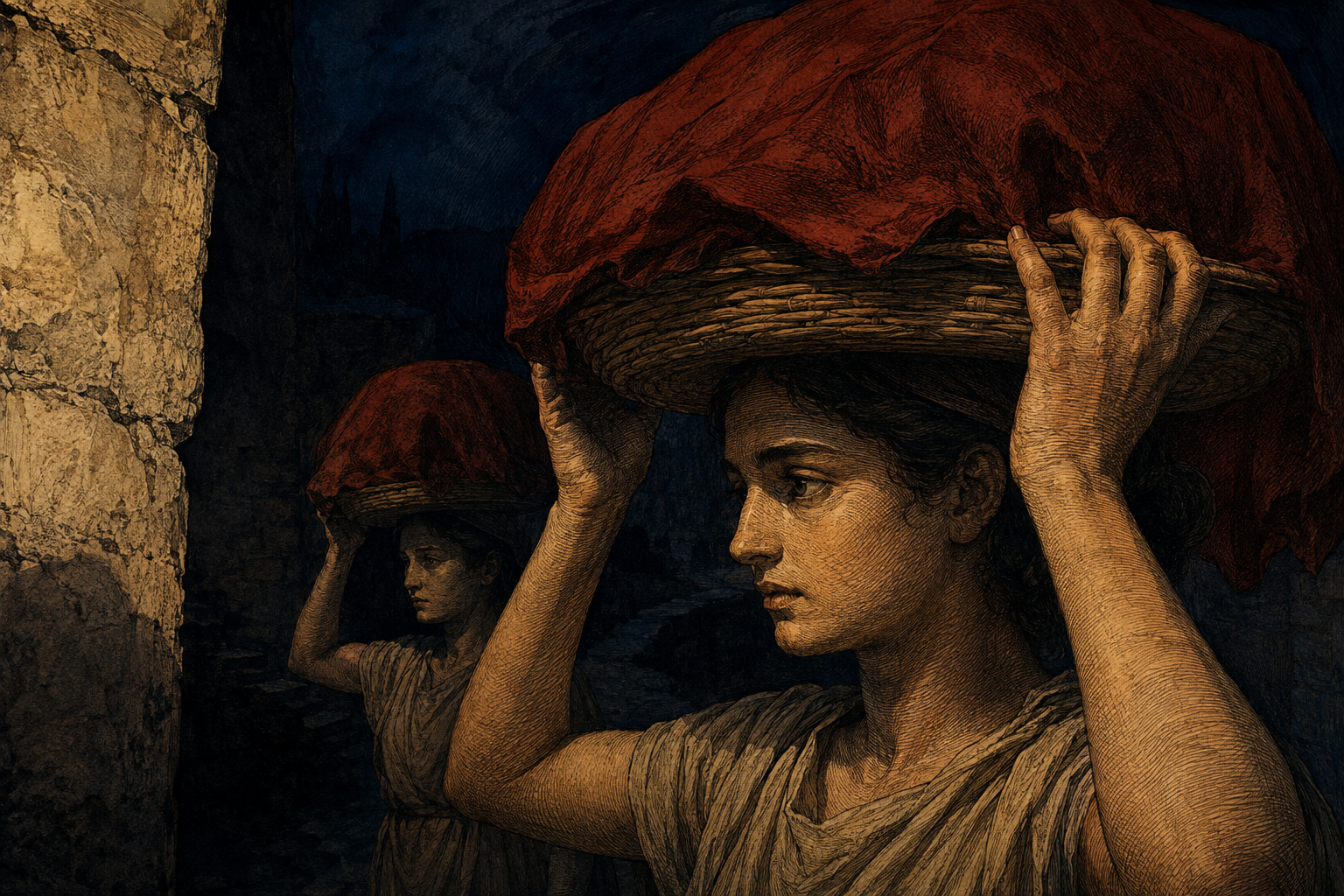
One night they are given a burden to carry below ground.

Neither the girls
nor the priestess knows
what is carried.

Within
the earth.

“the basket is
a pregnant belly?”

They set down
what they were given.

They receive something else
to carry back, covered.

Still covered.

Other girls
enter the same place.

Release to pause. Or scroll.Into depth ↗
An imagined route through the ancient account

Panarista.

One name the stone kept.

Her mother, Theodote, her father, Mantias, and her brothers commemorated her service as arrephoros.

The inscription does not name the burden.

The inscription, and the limits of what survives

A young girl
with flowers.

What the painting kept.

The opened painting

The surviving painting

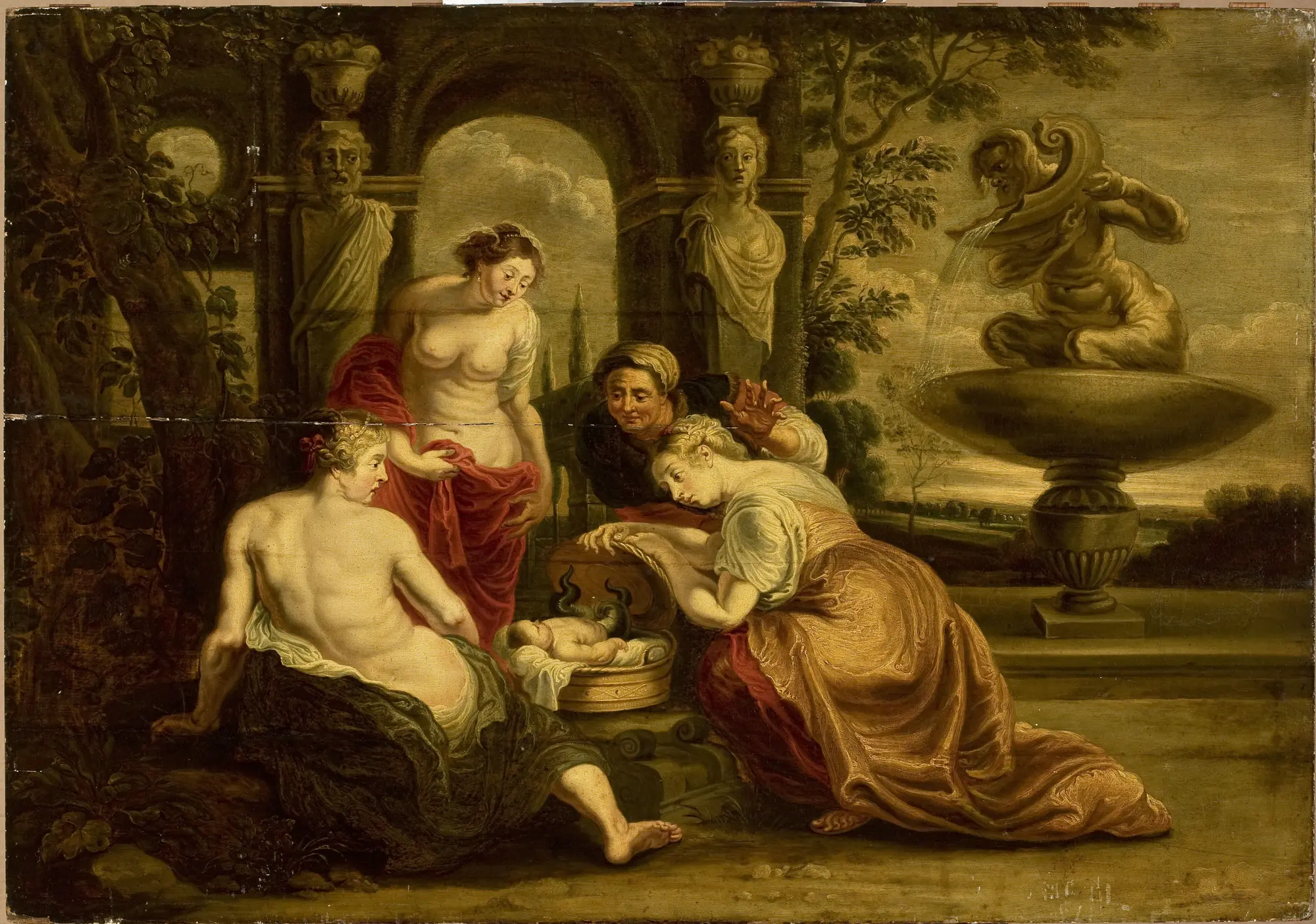
The Finding
of Erichthonius

Peter Paul Rubens, 1632–33
Allen Memorial Art Museum, Oberlin

The flowers can return.
We carry what we have seen.
Re-enter the story

Sources & staging

This theatre joins a painting’s documented history, a myth, an ancient description of a rite, and my interpretation. Their relationships are the work’s proposal.

Read alongside
A painted surface opens into myth, place, and ritual. Returning to the painting means meeting the same image with a different history.

The painting

Allen Memorial Art Museum’s record establishes the title and date, the cut and overpaint by 1786, Burchard’s recognition in 1939, and the rediscovery after cleaning. The display uses the project’s existing source reproduction. The museum associates this discovery scene with Ovid rather than the tradition of the sisters’ fatal leap. This describes the episode pictured here, not every later event in Ovid’s poem.

The earlier looking

The small window keeps a detail of the painting available during the passage. Its imagined flowers and recovered paint share the same image coordinates. This comparison crosses historical layers of the picture; it does not register the Acropolis geographically onto the painting or assert that Rubens intended this ritual connection.

The images between

The flower overpaint, Athena scene and pottery landscape are generated interpretations. The surviving Rubens and the Warsaw copy are source reproductions. The fragment’s alignment with the copy is approximate. The cleaning is an interpretive animation, not a record of the historical treatment. The first looking, cleaning and return use two cameras on the same painted surface: the whole gesture and a close view that enters the foreground. A touch in either view changes both. These are source-image crops, not newly generated details. The cut uses a continuous view from the fingers into the larger composition. The return holds the complete painting in its frame as the flowers clear. At the end, “Remember the flowers” restores the exact first surface over the recovered picture. That surface remains a generated reconstruction, not a photograph of the historical overpaint.

The near and distant views of the carriers are original generated illustrations. Their close-view and passage-view provenance records preserve the prompts and limits. They imagine bodily scale and enclosing earth; they do not document an established ritual route. The burden stays covered.

The original painted surface

The opening, cleaning and return use the flat painting. The camera approaches the image without shifting or bending its painted forms. The cleaning reveals the child beneath the imagined flowers; the return can cover him again. The separately generated moving interpretations follow later in the passage.

The birth and the prohibition

Apollodorus, Library 3.14.6 supplies the pursuit of Athena, the earth-born child and his secret care. The museum associates the opening Rubens paints with Ovid. The versions differ about the sisters and their fates; the theatre does not turn the fatal leap in other accounts into a depicted event in this painting.

The hand at the cut edge

Marjorie E. Wieseman’s AMAM catalogue and technical data identify Pandrosos’s surviving right hand at the basket and her right leg along the lower edge. The same account records concealed and abraded peripheral figures, cleaning in 1939, and Sarah Fischer’s further treatment in 1976–77. The cut scene magnifies the actual source image before showing the surviving larger composition in a copy. It does not restore the lost original canvas. Following this painted Pandrosos into the sanctuary named by Pausanias is the theatre’s interpretive route; no direct use of Pausanias by Rubens is asserted.

Athena and Hephaestus

The University of Missouri’s museum identifies Paris Bordone’s painting as Athena Scorning the Advances of Hephaestus, c. 1555–60, accession 61.78. The reproduction comes from the Kress Foundation’s public-domain image. Its older catalogue entry favored a different identification, Thetis requesting Achilles’s armor. The museum’s later study, Erotica Veneziana, argues for Athena and discusses the exposed thigh in relation to Apollodorus. The theatre follows the museum’s current identification. Its camera reframes the source; no figure is redrawn or animated.

The earth-born child

Apollodorus 3.14.6 gives the attempted assault, semen on Athena’s leg, wiping with wool and throwing it on the ground, the birth, and her secret fostering of the child with the intention of making him immortal. He describes a serpent coiled around the infant. Hyginus, Fabulae 166, instead describes snake-shaped lower limbs; Oberlin’s record identifies Rubens’s child as snake-legged. These are differing representations. The relation between the two acts of wiping is our reading, not proof of an intention by Rubens. Cleveland’s lekythos is an ancient depiction of Ge transferring the child to Athena.

The legend inhabits the place

Pausanias 1.27.2–3 places Pandrosos’s sanctuary beside Athena’s temple, calls her faithful to the trust, then describes the nearby girls and their rite. This sequence is in the text. Reading the rite beside the legend is our interpretation; Pausanias does not explicitly call it a reenactment. He says neither carriers nor priestess knows the contents, and that other girls replace those who return.

Related readings

The Pandora reading distinguishes Hesiod’s jar from the later box and places the pregnancy and agricultural interpretation beside relevant scholarship. Pausanias 1.24.7 describes Pandora’s birth beneath Athena Parthenos and tentatively identifies the nearby serpent as Erichthonius. Psyche’s descent offers an explicitly forbidden opening in Apuleius. The transmission of Pausanias concerns a lost exemplar and surviving copies, not a literal palimpsest or an established source directly used by Rubens.

One surviving name

IG II² 3488, dated a little before 103/2 BCE, records a family dedication for Panarista after her service as arrephoros. She is not identified here with either of the unnamed girls in Pausanias, who wrote centuries later. The words [and Pandrosos] in the inscription are restored by editors, not wholly surviving on the stone.

The passage and the body

The sanctuary transition uses the same imagined pottery landscape as the passage. It stages the adjacency of two passages in Pausanias, not a measured or identified location for the sanctuaries. The route shown is imagined. Scholarship disputes how Pausanias’s underground passage relates to the surviving archaeology. Its contents remain unidentified. The basket question brings pregnancy into this reading without identifying the burden as a child. The Chronotope of the Virtual explores how a passage transforms the body moving through it: “The form holds the content.” The earth holding the girls and the return to the painted gesture are the theatre’s poetic construction. Read the passage more closely.

The Athena plate’s arm, lid and serpent are articulated over a generated clean background. The historical Rubens remains a source reproduction; the two hand details are magnifications of it. Athena animation provenance.

This new production preserves the original pottery animation and small carrier illustrations. Touching the flowers reveals the source image through your own marks; the Uncover button offers the same discovery by keyboard. Scrolling or holding Walk moves the passage, and releasing stops it. These gestures are staging, not simulations of ancient initiation. Reduced motion uses still tableaux. No sound plays.

Follow the genealogy of the basket, the rock, the image, and the hand

Open the close-looking study

The earth hands over her child

An Attic red-figure lekythos. On its body, seated Ge offers the child Erichthonios to Athena.
Attributed to the Meidias Painter, c. 420–410 BCE.
Cleveland Museum of Art, 1982.142. Open Access.

On this vessel, the seated earth goddess Ge hands Erichthonios to Athena. The birth and the transfer of care belong to this same story.

The museum identifies only female onlookers here, including figures likely to be Kekrops’s three daughters. We encounter the sisters before the basket is entrusted to them.

Examine the museum’s record

The painting and the basket

A painting about opening a forbidden container has itself become a container.

I’ve been thinking about this painting for twenty years. What holds me is a metaphor embodied: the painting performed the role of the sealed basket, hiding a terrible chthonic secret.

Flowers offered one picture. Beneath them lay an earth-born child with a serpent’s body. The painted surface was keeping what the basket kept. Cleaning opened one enclosure and disclosed the opening of another.

The viewer enters that repetition. Touching the flowers uncovers a discovery already taking place inside the image. The act of looking acquires a place within the story it reveals.

Then the child moves. His tenderness survives the strangeness of his body. What has been kept from view is alive. The image opens into a world: Athena’s resistance, a birth from the earth, her care for the child and her instruction to keep him hidden. Our moving reconstructions give an imagined continuation to what the painted surface contains.

The ritual brings another relation to the secret. Beside his account of Pandrosos’s sanctuary, Pausanias describes girls carrying unknown burdens below ground. Their contents remain undisclosed. The girls carry something through the earth, and the earth encloses the girls. As the landscape curves around a vessel, the image gives this containment another body.

The form holds the content. The architecture of a passage can transform the person moving through it. Here, the painting’s frame, the covered basket and the enclosing landscape let us encounter that relation at different scales. Read the complete passage.

This is the theatre’s interpretation of the painting’s history and the ancient accounts. The ritual burdens remain unidentified; their resemblance to the child’s basket is a connection we explore. The invented viewpoints add our own layer to the surviving image.

At the end, the flowers can cover the child again. The same surface now holds the memory of what we found beneath it.

The flowers return.
We carry what we have seen.

The story, at your pace

Read the complete story without animation

By Douglas Goldstein

The Cleaning

Paris, 1786

A girl. A basket. Flowers. That was the picture offered for sale. Its edges had been cut away. Blossoms covered what she held.

A recognition, 1939

Ludwig Burchard recognized the composition from a print after Rubens. He suggested cleaning it.

Beneath the flowers, a child. The painting was keeping him, too.

At the cut edge

Her hand survived. Most of her body did not. The surviving fingers lead us toward the larger composition preserved in a copy after Rubens. A spectral tracing gives the missing body an outline. Its alignment with the fragment is approximate.

Pandrosos. The sister Pausanias calls faithful to what was entrusted.

Before the basket

In Apollodorus 3.14.6, Hephaestus tries to force himself on Athena. She resists. His semen falls on her leg; she wipes it off with wool and throws it to the ground. The earth bears Erichthonius. Athena takes the child into her care.

What the flowers concealed

The imagined child moves in his basket. His tail carries our gaze into a transformation: color becomes terracotta, a body takes the lines of pottery painting, and the view draws back to Athena.

She means to make him immortal. She raises him in secret.

Keep it closed. Athena entrusts the child to the daughters of Cecrops.

Pandrosos, again

The sister who kept faith has a sanctuary beside Athena’s temple. In the next passage, Pausanias describes two girls taking unknown things below ground.

This adjacency in Pausanias is our way into the ritual. He does not explicitly identify it as a reenactment of the myth. The girls’ burdens remain unknown.

The way below

The original pottery drawing opens into an imagined landscape with depth. Two girls carry their covered burdens through it. Neither the girls nor the priestess knows what they carry.

Small illustrated panels bring us close to the weight above a girl’s head and the rock around her body.

Within the earth

The earth holds the carriers. As the view withdraws, the landscape curves around a vessel. The form holds the content. This enclosing form is the theatre’s poetic construction.

The exchange

They set down what they brought. Something else is given to them, covered, to carry back. The exchange stays out of view.

The same path, returning. Their service ends. Other girls enter the same place.

One name the stone kept

Panarista. Her mother, Theodote, her father, Mantias, and her brothers commemorated her service as arrephoros in a dedication on the Acropolis, a little before 103/2 BCE.

The inscription preserves a person’s name. It does not name the burden. Panarista is not identified with either of Pausanias’s unnamed girls.

Around the opened basket

We return to the women through an imagined twenty-second orbit. The moment of opening: Aglauros lifts the lid. The reconstructed viewpoint adds a new interpretation to the surviving painting.

The second looking

The whole painting returns within its frame. A young girl with flowers. The flowers clear to reveal the child.

What the painting kept.

The earlier flowers remain available within a movable window over the recovered picture.

The Finding of Erichthonius

Peter Paul Rubens, 1632–33. Allen Memorial Art Museum, Oberlin. A surviving fragment.

The flowers can return. We carry what we have seen.
Continue into the sources and readings