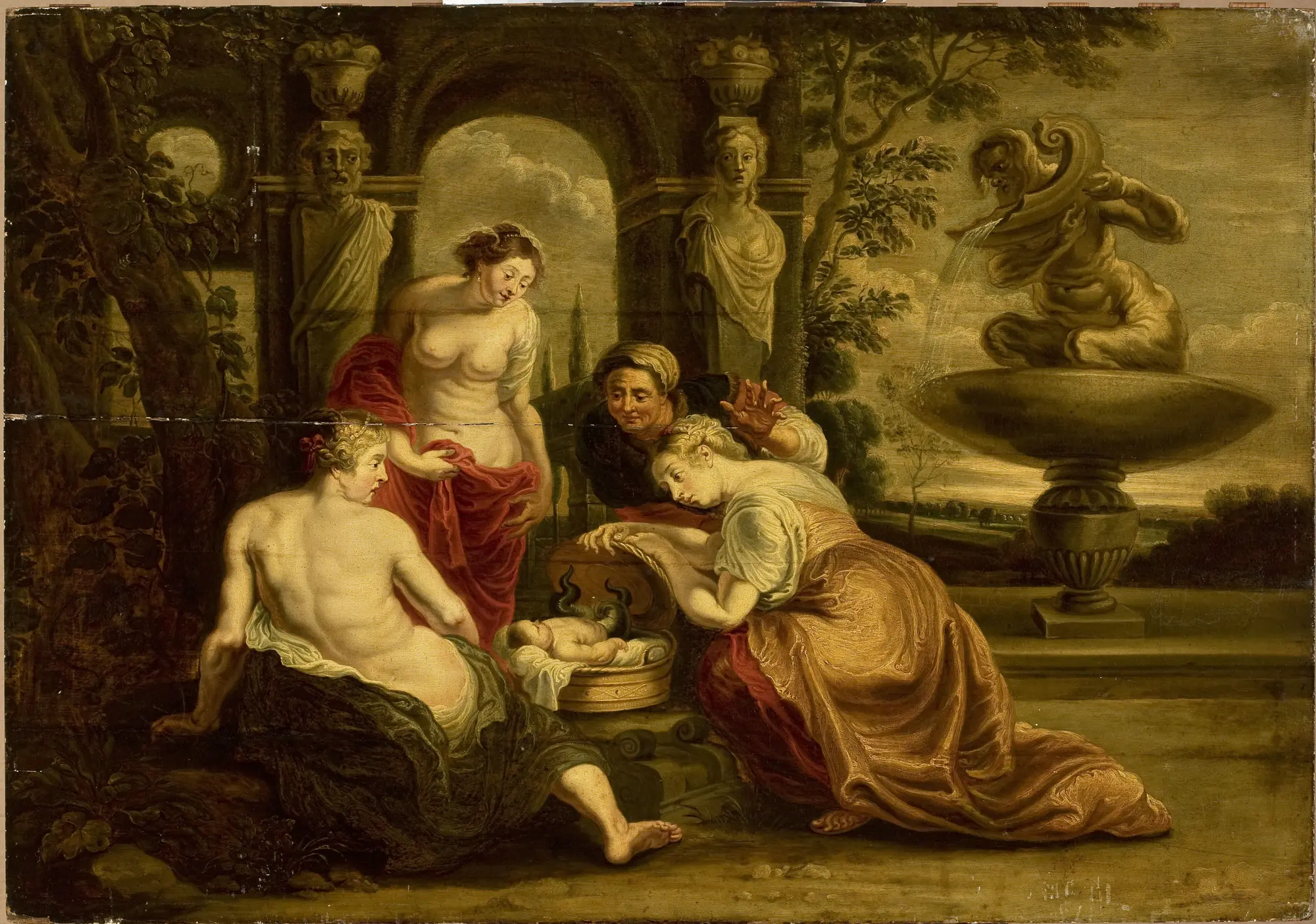
Two different objects. The Warsaw copy preserves the larger composition. The Oberlin painting is the surviving fragment by Rubens. Their alignment is approximate.
What the sources let us say
Marjorie E. Wieseman’s Oberlin catalogue identifies Aglauros in gold, Herse standing at left, Pandrosos reclining in the foreground, the old nurse, and the portico’s references to Vulcan and Gaea. It attributes the fingers and leg along the fragment’s edges to Pandrosos. The current museum record documents the fragment’s transformation and the witnesses to the wider composition.
Pausanias 1.27.2–3 places his description of the girls and their unknown burdens immediately after Pandrosos’s sanctuary. This is our route between painting and rite. It does not establish that Rubens intended the Arrhephoria or that the ritual reenacts this painting’s story.
The opening film uses an imagined expanded composition with added drapery. Its camera movement, gestures and absent viewpoints are generated interpretations, not recovered Rubens surfaces. The child and Athena now open the pottery passage. The subsequent source passage enlarges the unchanged Warsaw reproduction. We do not assign an individual parent to either stone figure here.
Passage notes and source distinctions