A child. A name. The shape of a vanished picture. Someone else’s time.
Begin with something you encountered. Follow what it touches.
Ancient accounts, surviving objects, and my writing meet here. Some connections are explicit in the sources. Others are this theatre’s readings. Each passage tells you which.
The basket
A trust that can be broken
A container does more than hide. It places someone in another person’s care.
In Apollodorus’s account, Athena conceals Erichthonius in a chest and entrusts it to Pandrosos, one of Cecrops’s daughters, with an instruction against opening. Custody arrives before knowledge. The recipient is responsible for something she has not been permitted to inspect. Apollodorus, Library 3.14.6
Ovid arranges the breach differently. Aglauros opens while Herse and Pandrosos obey; a boy lies beside a serpent. The crow that reports the discovery loses Athena’s favor. This opening episode contains no fatal leap. Ovid, Metamorphoses 2.552–565
The theatre’s connection begins with a distinction: the painted opening and the ritual’s carrying place different demands on those who keep what is hidden. Their resemblance matters because their actions diverge. The recovery of the image lets that difference become visible.
The crow’s voice
A story inside a warning
The casket story is itself being carried. Its teller hopes to change what another teller will do.
The raven flies to tell Apollo about Coronis.
The crow stops it with a warning from experience.
Aglauros opened Athena’s chest. The crow reported it and lost the goddess’s favor.
Earlier still, Athena had made the crow a bird to save her from Neptune’s pursuit.
Ovid, Metamorphoses 2.531–595. The crow tells the Erichthonius story; the raven reports to Apollo. Coronis, Apollo’s lover, is another person.
Leaving the crow’s memories brings us to another endangered child. The raven ignores the warning. Apollo kills Coronis, then saves their son Asclepius from her womb and the pyre, entrusting him to Chiron. Chiron’s daughter Ocyrrhoe foretells the infant’s healing and revival of the dead. Her speech becomes neighing as she turns into a mare. A future enters the child’s infancy through a voice that cannot finish speaking. Ovid 2.596–675, Latin with Boxus–Poucet translation
The earlier breach returns later: Minerva remembers Aglauros’s opening before she sends Envy against her. Ovid’s narrative has not forgotten the casket. Ovid 2.752–759
This nesting is in the poem, not an ancestry invented for the theatre. A witness has a history; the history becomes a warning; the warning reaches someone who refuses it. Going deeper changes our understanding of the voice that first seemed to tell the story from outside. The questions shift from what was hidden to who is speaking, why they speak now, and whether being heard is enough.
Wool and ground
A child with divided origins
Earth produces him. Athena raises him. The story does not give all the work of motherhood to one body.
Apollodorus tells of Hephaestus pursuing a resisting Athena. She wipes his semen from her leg with wool and throws it to the ground; Erichthonius is born. Athena then secretly nurtures him and intends to make him immortal. A piece of textile carries the consequence between bodies and earth. The attempted assault remains an assault; the care that follows does not undo it. Apollodorus, Library 3.14.6
An older name lies beneath this familiar name. The Iliad calls Erechtheus earthborn and Athena-nurtured, established in her sanctuary and honored by Athenians. It does not yet tell the full chest story. Later genealogies distinguish Erechtheus from Erichthonius. The texts preserve a seam; they do not establish that the names were always separate, or always one. Homer, Iliad 2.546–551
Here, “earthborn” opens a question of belonging. A body may have several origins: the event that produces it, the hands that tend it, and the city that later tells its story.
The covered burden
The thing that comes back
You can be responsible for what you do not know.
Before the descent, Pausanias names Pandrosos. Her sanctuary stands beside Athena’s temple; she alone among the sisters is innocent concerning the parakatathēkē, the entrusted deposit. The word gives the hidden child a relation: someone has placed him in another’s keeping. A secret becomes a responsibility. Then Pausanias turns to the girls who live nearby. Pausanias 1.27.2–3, Greek terms with Nagy’s retranslation
Pausanias describes two girls living near Athena’s temple. At night they carry burdens on their heads. Neither they nor the priestess who gives the objects knows what is inside. They descend by a passage, put down what they have carried, and return with another covered thing. Afterward, other girls take their place. Pausanias, Description of Greece 1.27.2–3
A girl’s name survives outside that account. Shortly before 103/2 BCE, Panarista’s family commemorated her service as arrephoros. The edited dedication names Athena Polias [and Pandrosos]. Those brackets matter: Pandrosos’s name is restored where the stone is missing. We recover a person and an office, through a damaged record; the dedication does not name the burden. Public remembrance and ritual secrecy can occupy the same life. Panarista’s dedication, IG II² 3488
Is the basket a pregnant belly? The force of the question lies in time. A body carries a life before anyone knows who that person will become. Responsibility begins before that knowledge arrives. In this theatre’s reading, the girls hold the covered things while the earth holds the girls. Their passage can acquire meaning without the contents becoming ours to inspect.
The rite returns us to Rubens with a difficulty. We have wanted the covering removed. We now recognize a hand opening what it was entrusted to keep closed. The same desire to see has brought us to both discoveries.
What the ancient account says—and what this reading adds
Pausanias’s sequence joins the sanctuary and the rite without explicitly calling one a reenactment of the other. Parker notes that the return burden has no counterpart in the casket myth. Parker, Polytheism and Society at Athens, pp. 221–223The linked copy may require institutional access.
The opening Greek phrase, οὐκ ἐς ἅπαντας γνώριμα, says these things are not known to everyone. It does not establish that they are unknowable. Pausanias describes nonknowledge, a covered return, and the girls’ replacement; he does not expressly record a prohibition on the carriers looking or describe their inner transformation. Pregnancy and bodily transformation are the connections I’m exploring here. Greek text and discussion in Sardak, “By Torchlight”.
The building identified as the secret-bearers’ house has itself been covered again, to keep it safe.
Near the Erechtheion, fragile foundations survive from the building identified as the Arrhephorion. The Acropolis Restoration Service records their reburial to protect the stone. The covering is an act of care: the remains endure beneath the surface. The building’s identification; the conservation record
The descent has an older material possibility, too. A Mycenaean stair entered a fissure to reach water. Broneer connected its upper passage with the later Arrhephoria. The waterworks are excavated remains; the ritual route is a disputed identification. His further suggestion that a fatal collapse generated the sisters’ legend remains speculation. Broneer, A Mycenaean Fountain, pp. 423, 428–429
An apparently empty surface can be a carefully kept inheritance. The girls’ house becomes less visible so that it can survive. Coming here from the cleaned painting, we meet an opposite act of conservation: one covering removed, another laid down. What a surface conceals can change what it asks us to do.
This is a spatial palimpsest in the theatre’s sense. Knowledge makes a familiar patch of ground hold another time. The present surface remains; the remembered dwelling changes the experience of standing beside it. The body enters the relation between those times.
The route and the limits of its reconstruction
Sardak’s 2023 rereading places the underground action within a sacred enclosure and questions the familiar continuous route from the summit. Her proposed cave is distinct from the Mycenaean water passage. This remains a reconstruction of a disputed route. Sardak, pp. 83–90.
A small child found near a cave
A different cave within the north-slope sanctuary yielded a sleeping-child figurine, just 6.5 centimetres long, its head resting on its hands. Broneer considered that it had arrived in debris from above. It has no secure identification as Erichthonius or an Arrhephoric burden. The resemblance invites attention, while the find circumstances prevent us from turning it into a recovered ritual secret. Broneer, 1933, pp. 337–338, fig. 9.
Aglauros’s sanctuary
Called as witness
The name remembered for opening the chest also helps guarantee a city’s fidelity.
The ephebic oath preserved at Acharnai invokes Aglauros among its witnesses. It also invokes the territory and its crops: a political obligation is spoken before an inhabited and cultivated landscape. The inscription gives her name civic work beyond the casket story. Acharnai oath, RO 88, lines 5–20, ca. 335–325 BCE
Another inscription honors Timokrite, priestess of Aglauros, for sacrifices and the orderly conduct of an all-night celebration. It is evidence for this sanctuary’s living practice. Decree for Timokrite, IG II³ 1, 1002, lines 9–38
The stele was found still in its base beneath the large cave on the east slope on 16 April 1980. Its discovery shifted the sanctuary’s identification away from the north slope; the excavation report appeared in 1983. An object returned a name to a place, and the map had to change. Dontas, “The True Aglaurion,” pp. 48–63
Aglauros also returns through the work of cleaning. Photios preserves a tradition that Athena’s sacred garments went unwashed for a year after her death. Plutarch describes the Plynteria’s secret removal of the goddess’s robes and covering of her image. The girl who exposed the hidden child belongs to another tradition of care for an image withdrawn from sight. Photios’s testimony discussed by Manakidou; Plutarch, Alcibiades 34.1
A character’s remembered mistake cannot contain everything people later ask her name to do. Prohibition in a story, obligation in a city, a death remembered in the washing of a cloth: the same name keeps opening into another life.
The warp
Before there is a cloth
There is a material bridge between the girls’ service and Athena’s garment: the work of beginning it.
The Byzantine Suda says priestesses and arrhephoroi set up the peplos’s warp at the Chalkeia. It is a late witness, but a specific one. Setting up the loom locates sacred service in a trained action; it does not establish that these girls wove the entire finished garment. Suda, χ 35, David Whitehead translation
Herse and Pandrosos have dew-related names. Such names have encouraged fertility readings of the rite. Yet a suggestive name cannot identify a covered burden. Flora Manakidou treats the competing etymologies and connections as interpretive possibilities. Manakidou, “Pandora, Athena, the Kekropides, and the Erechtheides,” §3
“The chopping does not change. The chopping’s significance changes.”
Repeated skilled movement can acquire another frame. I explore this in the kitchen, where familiar actions take on ritual significance. The resonance does not establish a common historical origin for the kitchen and the Chalkeia.
The surviving object does not carry all the information needed to recognize itself.
The Allen Memorial Art Museum’s Rubens fragment comes from The Finding of Erichthonius, painted in 1632–33. By 1786, it had been cut down and overpainted. In 1939, a print enabled the altered fragment to be recognized. An image traveling in another medium had kept the composition legible. AMAM, object 1944.96
Look at the hand entering from the left, beside the child. The museum’s earlier catalogue identifies it as Pandrosos’s right hand; her right leg also survives across the lower edge. Most of her figure was cut away. These remnants, too, had been covered with paint. The person who will lead us toward the sanctuary is already touching the basket in the fragment. Marjorie E. Wieseman, AMAM Rubens catalogue, discussion and Technical Data
The catalogue records several stages of alteration. Peripheral figures were deliberately abraded, probably to prepare them for concealment. The 1939 cleaning removed most of the overpaint; conservator Sarah Fischer removed the remaining additions in 1976–77. The surviving canvas had been made to tell a smaller story by cutting, wearing away and painting over. These are findings about the object’s treatment, distinct from the theatre’s imagined reconstruction of its flowers. AMAM, Technical Data; citing Fischer’s examination and treatment
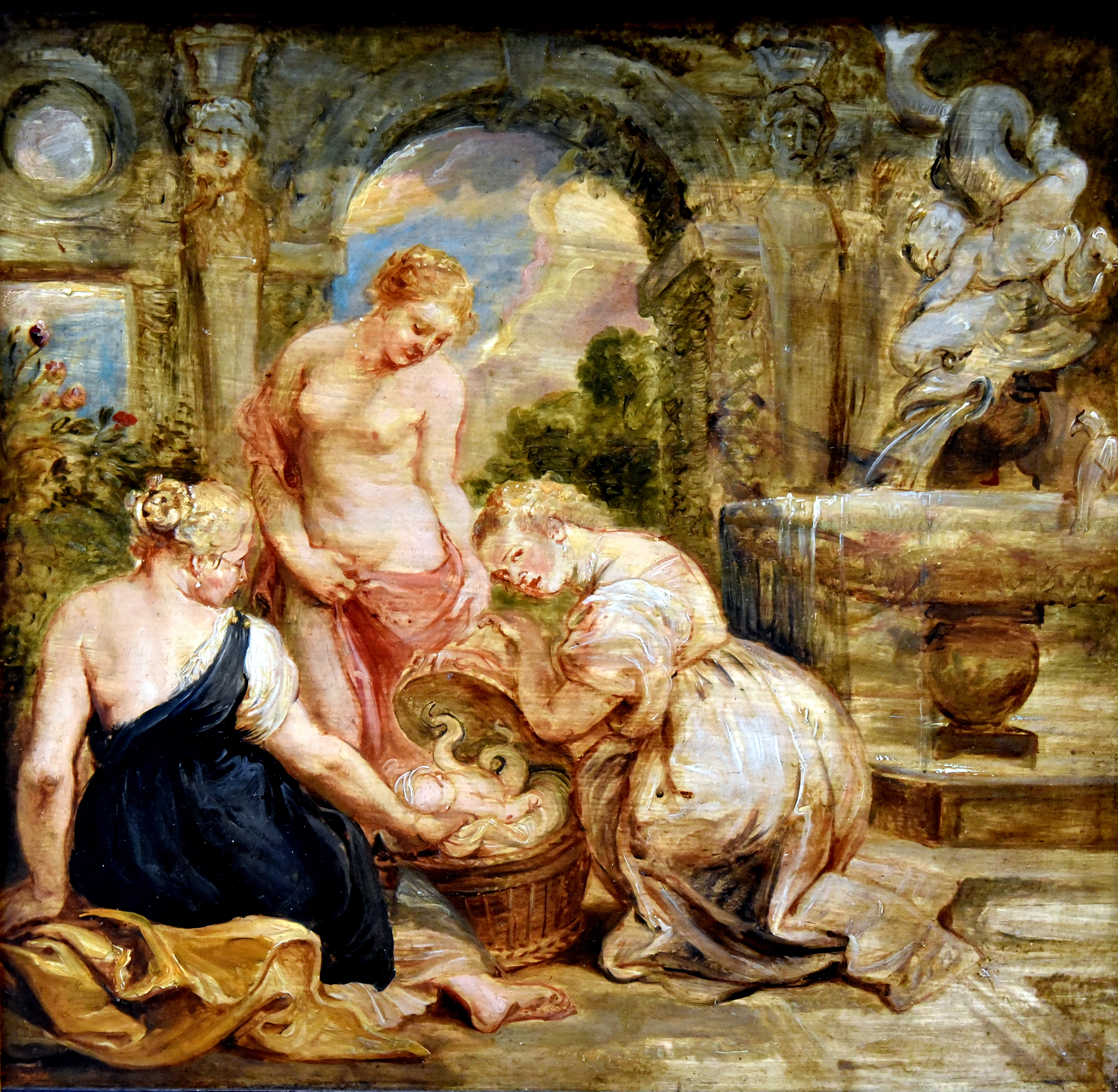
Peter Paul Rubens, Cecrops’ Daughters Finding Erichthonius (sketch), c. 1632. Oil on oak, 31 × 33 cm. Nationalmuseum, NM 607. Photograph by Osama Shukir Muhammed Amin FRCP(Glasg), CC BY-SA 4.0, via Wikimedia Commons. Photograph unchanged.
This earlier conception in Stockholm lets the three sisters gather around the opened basket beneath an arch and two herms. A male fountain figure occupies the right; there is no old nurse. Compare the final composition in the theatre: figures and fountain have moved, and another witness has joined them. The sketch belongs to the making of that painting, but it is not an exact record of its lost surroundings. AMAM’s earlier Rubens catalogue
The available Van Sompel engravings are a more treacherous resemblance. They preserve a different Rubens design: a many-breasted fountain figure at left, different poses, a dog, and putti. The Corpus Rubenianum distinguishes the engraving as no. 41b, the Oberlin fragment as no. 42, and the Stockholm sketch as no. 42a. The exact print involved in the 1939 identification remains unestablished here. A similar subject is not sufficient evidence of the same composition. Corpus Rubenianum XI.1, vol. 2, list of figures, p. 15
The overpaint changed the action of the hands. For generations they appeared to tend flowers; recovered, they open something entrusted to the girl under a prohibition. The gesture survived inside a different story. A viewer could live beside it, know its colors and contours intimately, and never know what the hand was doing.
Pandrosos gives that return a particular direction. Pausanias names her as faithful to the trust and describes her sanctuary; in the next passage he turns to the neighboring girls and their covered exchange. We follow the painted fingers into the missing figure, and her name into that place. This is the theatre’s reading across the objects and text, not evidence that Rubens intended the ritual connection or that the rite simply reenacted the myth. Back at the basket, Aglauros lifts the lid while Pandrosos’s hand remains at its edge. Their painted instant now holds the time we spent following the girls.
The words that brought us here
The book that disappeared
We follow Pausanias into the rock. Follow his words toward us, and another absence opens.
Aubrey Diller reconstructs the surviving manuscript tradition through Niccoli’s exemplar. After Niccoli’s death, the book was kept at San Marco in Florence. It subsequently disappeared. Its descendants survived: the source behind them can be studied through copies, shared readings and errors, although the source itself can no longer be consulted. Diller, “The Manuscripts of Pausanias,” TAPA 88 (1957), pp. 169–171
One surviving witness is the Laurentian manuscript Plut. 56.11, catalogued as a fifteenth-century parchment codex. It is available to turn through, page by page. This is a copy, not Pausanias’s autograph, and this transmission history gives us no basis for calling it an erased-and-rewritten palimpsest. Biblioteca Medicea Laurenziana, Plut. 56.11
The resemblance to the girls’ carrying changes as we attend to it. These readers wanted to know what the book said. They copied an accessible text; the girls carried undisclosed things. The missing manuscript is a loss, not a prohibition. Yet both encounters make us ask what can be entrusted to hands, and what those hands can leave for someone else.
A print helped a reader recognize Rubens beneath the flowers. Copies let us read the sentence beside Pandrosos’s sanctuary. Looking back, the objects that seemed secondary—the reproduction, the borrowed book—have become the means by which the past can reach us at all.
Pandora · clay, grain, expectation
A vessel for the future
Pandora was already here, beneath Athena.
Pandora is already present in the Acropolis’s art. Pausanias describes her birth on the pedestal of Athena Parthenos. In the same paragraph he mentions the serpent beside the goddess, tentatively identifying it as Erichthonius. This shared setting gives us a place to read their stories together. Pausanias 1.24.7
A jar can keep what a household will need after the harvest is gone. The pithos belongs to the material world of agricultural storage. Jars from Knossos held produce such as grain and pulses, wine and oil. This gives the vessel a relation to seasons, reserves and continuance before we read it as a symbol. Ashmolean Museum, “Clay pithos”
Hesiod places Pandora’s story after Zeus hides humanity’s livelihood. She is fashioned from earth and water; she lifts a jar’s lid; evils escape and elpis, conventionally translated “hope,” remains. The poem does not identify a seed in that jar. Its stated warning is to Epimetheus against accepting Zeus’s gift, rather than an order to Pandora never to open the vessel. Hesiod, Works and Days 42–105
“This is also a metaphor for pregnancy and agriculture”
There is scholarship behind this reading of containment. Yurie Hong examines the jar as a womb metaphor and the retained elpis as an uncertain potential for what may come. Kaitlyn Boulding connects Hesiod’s concealed grain, storage jars, bodily hunger and generation. These are interpretations of the poems’ reproductive and economic imagery; they do not reveal the Arrhephoria’s burden. Hong, “Poetic Authority and the Utility of Reproduction,” §3.6; Boulding, “Pandora as Stomach, Womb, and Wonder,” pp. 14, 17–19
A seed kept for sowing and a child carried before birth introduce a time that cannot be hurried into visibility. A covered vessel can hold a future. That possibility presses against the frightening openings of the myths. The stories also carry male fears about women’s bodies; a reading of generation should let us notice those fears, without accepting them as the women’s own experience.
How the jar became the box we remember
In his Renaissance retelling, Erasmus substituted pyxis, a box, for the great jar. Dora and Erwin Panofsky trace this change and propose contamination from Psyche’s story. The substitution is documented; the explanation of how it happened remains a scholarly hypothesis. Dora and Erwin Panofsky, Pandora’s Box, “The Origin of the ‘Box’: Erasmus of Rotterdam”.
The remembered ancient object has acquired a different shape through retelling. We arrive expecting a box. Reading changes what we thought we had already seen. That is an analogy with the theatre’s recovered painting, not evidence that Rubens intended a reference to Pandora.
Psyche · Apuleius, Metamorphoses 6.16–21
A different return
She comes back into daylight carrying something she has been told not to see.
Venus sends Psyche below ground to obtain some of Proserpina’s beauty in a box. A speaking tower gives her directions for descending and returning. It also warns her against opening the container. Psyche completes the journey, but on her return wants a little of its supposed beauty for herself. She opens it. What escapes is a deathlike sleep, which overcomes her body. Cupid subsequently removes that sleep, returns it to the box and wakes her. Apuleius, Book VI, Adlington translation, §§16–21
The descent, the receiving, the ascent: the arrangement recalls the Arrhephoria, then takes another course. In Pausanias, the received things remain covered and the girls’ service ends. He does not explicitly report a warning against looking. Apuleius does. His carrier crosses the threshold successfully, then opens what she has brought through it.
Resemblance need not establish descent from a common rite. It can make a difference perceptible. Reading structurally similar stories with opposing meanings lets us stay with that difference: the journey has not answered every question the returned object poses.
A question
Is the basket a pregnant belly?
I mean this as a question.
I’m interested in what carrying a hidden life does to a body, and in the time before that life becomes known.
The question can make us feel carrying differently: a body moving with an unseen life, a protective boundary, knowledge that arrives later. This is a contemporary interpretation. It does not identify the Arrhephoria’s objects or establish that the rite rehearsed pregnancy.
There is also a political pressure inside earth-maternity. In Plato’s Menexenus, the funeral speech gives the land priority over human mothers, making human reproduction imitate earth. The speech is rhetoric inside a dialogue, not a neutral statement of what all Greeks believed. A city can exalt maternity while displacing particular mothers. Plato, Menexenus 237b–238b
The Torah reader’s yad is a pointing hand that maintains a distance while making a relation possible. I place it beside fencing’s extended touch and the pointing-hand cursor. These connections explore what mediation can mean; they do not establish that a cursor’s designers consciously borrowed the yad.
“The distance is not a limitation of the interface. The distance is the content.”
The remembered object changes the design question. An intermediary need not be an inconvenience to remove. It may be the place where the significance of an action resides. The hand points; the distance remains meaningful.
The resonance with the carriers is ours: hands need not open everything they hold. Keeping a relation without possessing its contents can be a positive action. This correspondence does not propose a historical descent between Jewish textual practice and the Athenian rite.
Read the complete passage. The Hands Essay, 30 August 2026, §VI, “The Hand That May Not Touch,” lines 70–74.
Bark and surface
The heart under the bark
“Daphne’s heart still beats under the bark. Actaeon retains his human consciousness inside the stag’s body.”
I read Ovid’s metamorphoses through the persistence of a prior inhabitant. I call this “hylomorphic violence”: a newly imposed form does not necessarily extinguish the experience living inside it. This brings Aristotle’s matter and form into contact with the shapes of narrative.
“The transformation is complete in form but incomplete in experience. The body remembers what it was.”
The essay extends this thought to a city’s suppressed memories and to the ethics of designing experiences that people inhabit. Its question is what a form does to the body asked to enter it. The transformed participant carries something away.
Bark and overpaint can rhyme in this theatre because a surface need not exhaust what it contains. The rhyme remains a reading, not an equivalence between a painting’s treatment and violence against a person. What persists beneath an imposed frame is the question that keeps bringing me back.
Read the complete passage. The Chronotope of the Virtual, §VIII, lines 209–233; quoted metamorphosis paragraph at line 221.
Two stories held beside one another
The two Kings
The same arrangement can produce opposing moral worlds.
In day school, I learned to place two stories beside one another: the women before Solomon and the women and children during the siege in 2 Kings. Repeated structural elements sharpen the difference between the stories.
“The friction between them — the structural rhyme that produces opposite meanings — is not a puzzle to solve. It is a practice to inhabit.”
That practice led me to Columbia, to the peplos and Actaeon, and to the understanding that frames produce meaning.
Read the complete passage. The Two Kings Passage, 30 August 2026, lines 9–23; quoted sentence at line 19.
The city
All the poems at once
“The stones didn’t care which poem you’d read. They held all the poems at once.”
I encountered this in a Columbia classics seminar, a year after Oberlin, reading Catharine Edwards’s Writing Rome. Cicero, Ovid, and Juvenal occupy one physical city while making incompatible textual cities.
The recognition reached further back, to my childhood reading of a Talmud page: centuries present on one surface. “This is midrash at the scale of a city.” Bakhtin later gave me the word chronotope for something the seminar and theatre had already let me recognize.
Ovid’s Rome rereads Augustus’s. As a designer, I want to know whether someone entering a space can reread it against its intended meaning.
That is a demanding model for this room. The rock can retain a cult, a rape, a dance, an oath, and an uncertain archaeological identification without resolving them into a single official tour. Accumulation alone is not the achievement. Competing readings must remain capable of changing what the place means.
Read the complete passage. The Chronotope of the Virtual, §§I–II, lines 31–73; Bakhtin at §IV, line 109.
The passage
What we owe the bodies
“The ritual works because they don’t look. The form holds the content.”
Darkness, narrowness, descent, and ascent do the transformative work. This is how I understand a structured experience acting on its participant. The ancient rite’s route and meaning remain separate historical questions.
I want to understand how to design such tunnels and what we owe to the bodies we send through them. In Interdimensional Selfhood, I give a related requirement: “The frame must be reversible.” Its Seder-to-Windows genealogy joins performed temporal crossing to the need for a discoverable, navigable frame.
These ideas can coexist. An experience may leave something with a person while the interface permits leaving, returning, and comparing. A myth’s irreversible act is not a reason to trap a visitor. The room you are in preserves a way back to the theatre because meaningful withholding and the visitor’s agency must be held together.
Read the complete passage. The Chronotope of the Virtual, §IX, lines 251–259; Interdimensional Selfhood, lines 304–308. The tunnel-lock analogy in the earlier workshop record is a later design proposal.
The thing left for another
To be found in another time
“the whole idea behind this ultimately is that places can be palimpsests too.”
Richard McGuire’s Here gives me a way to think about interfaces that make a place’s several times visible. The connections can emerge gradually. Discovery is part of the experience.
I imagined the Pneumatic organs as a way for people to leave something in their time and place for another participant to find. That inscription would advance a shared experience. It remains a design intention; this reading room does not yet offer shared inscription.
Read the complete passage. Museum draft, 2 September 2026, §9, lines 361–370; The Assignment of Times, 14 August 2026, line 7.
The print kept a composition that the altered painting could no longer disclose. It reached a later reader and changed what the surviving surface meant. That delayed encounter belongs to this object’s documented history; it gives us a way to think about the time between making a trace and finding it.
._Nationalmuseum,_Stockholm,_Sweden.jpg)