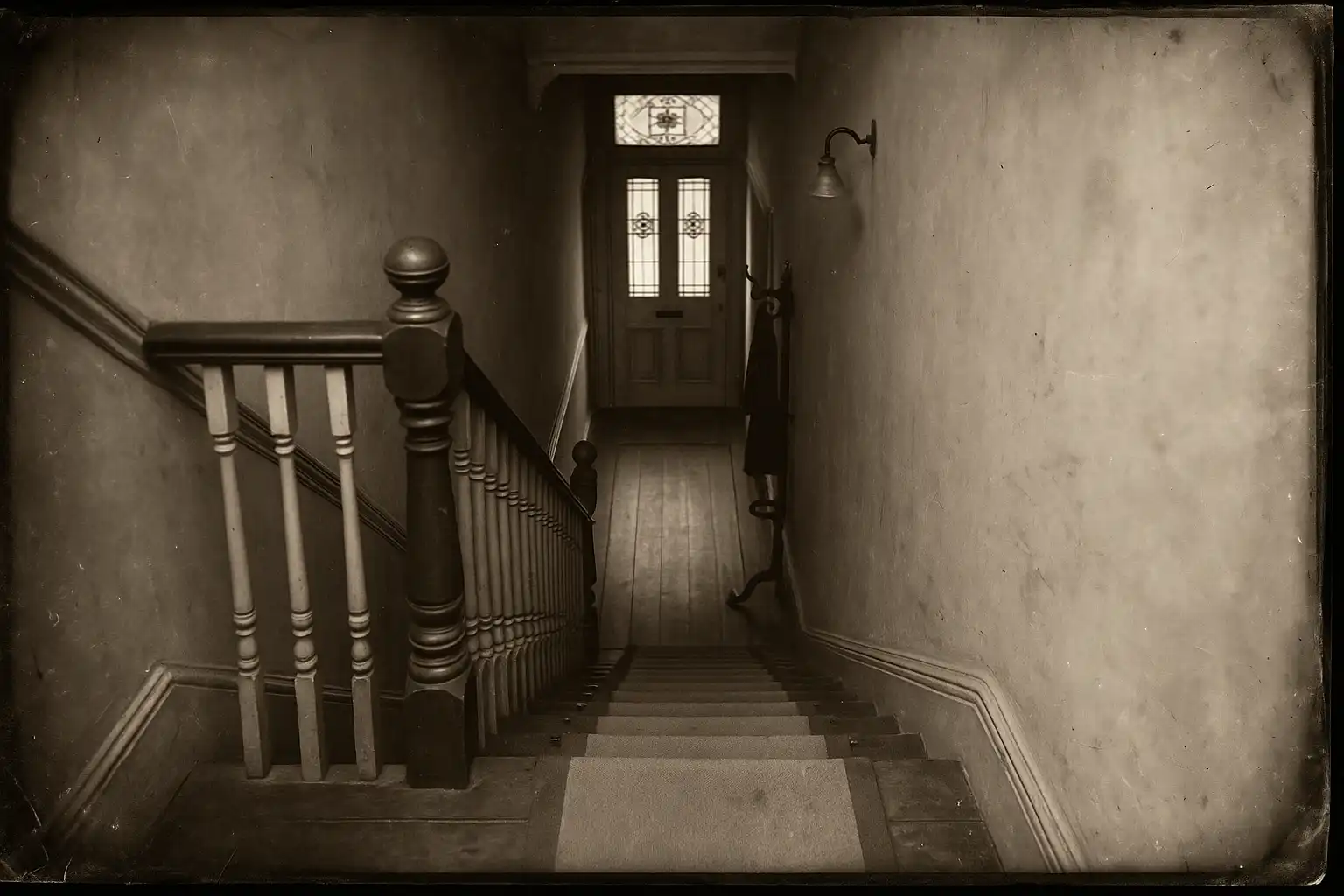
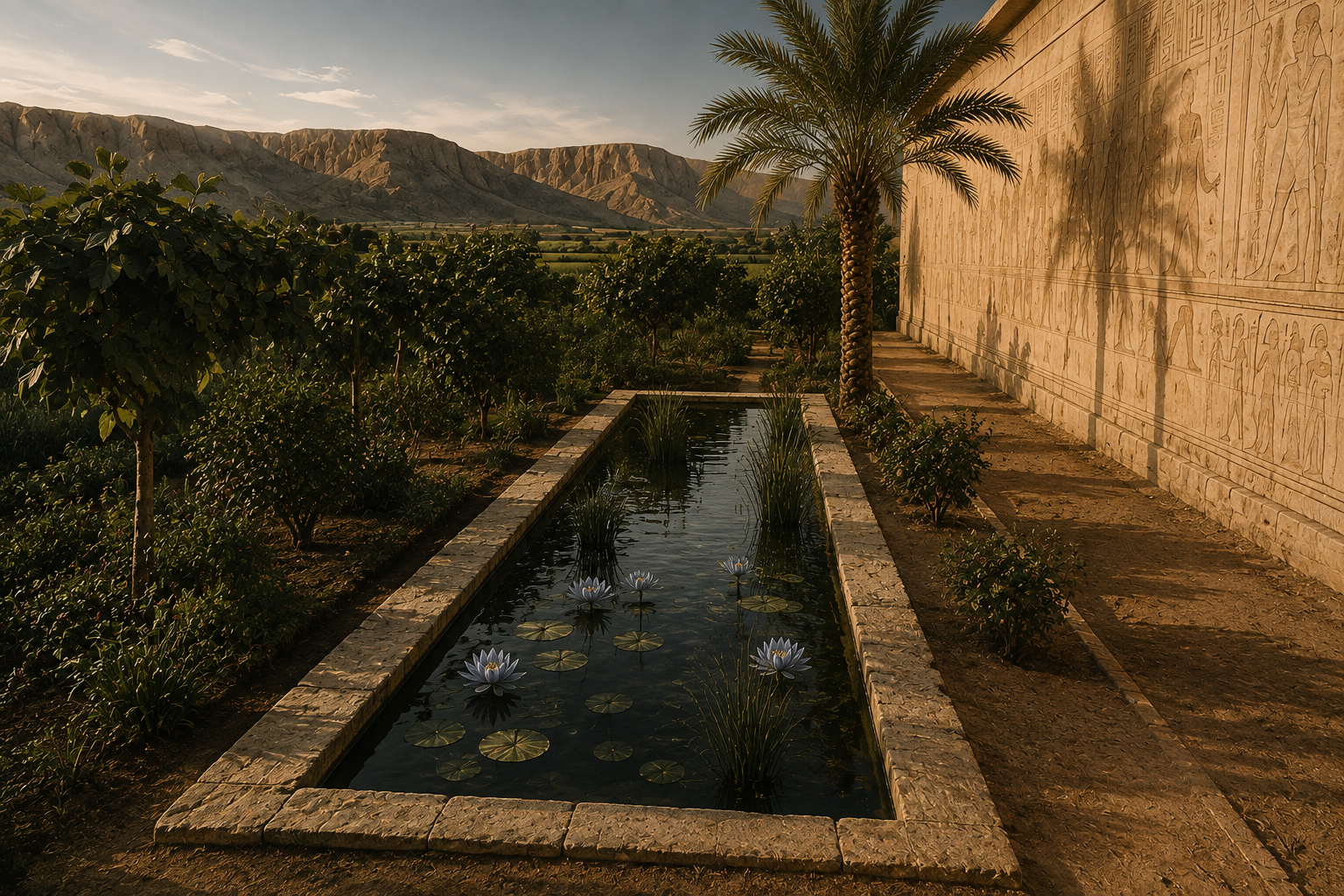
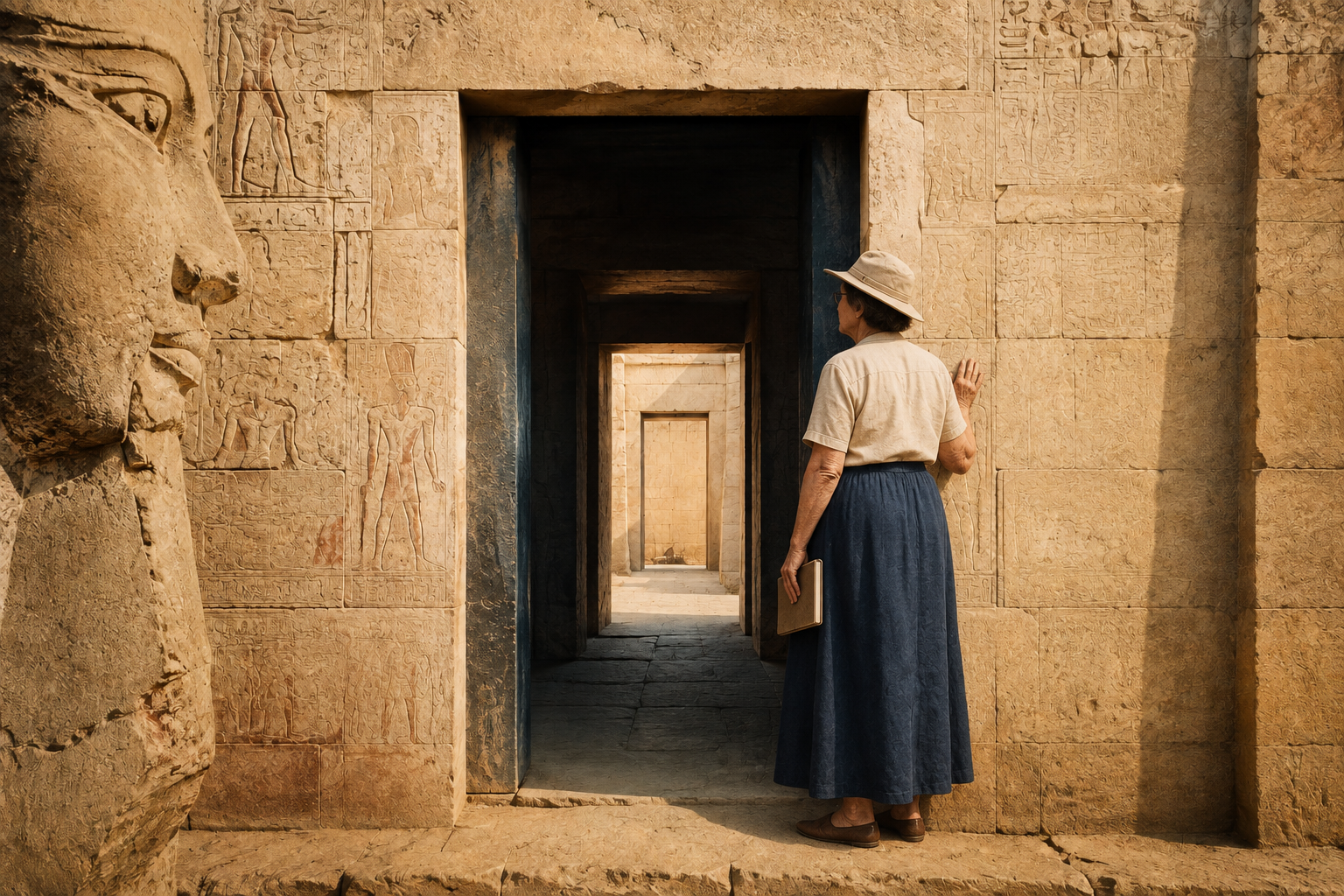
This is Dorothy Eady’s life, and the ancient life she said she remembered. You do not have to decide what happened before you enter. Scroll at your own pace; reverse direction to return. Sound is optional. In the opening, your scroll carries the descent, a child’s searching look, her walk among columns, and her touch in the museum. Stop to hold a moment; scroll back to retrace it. The lens moves between remembered and inhabited places, and between the selves who belong to them. At the doorway, Dorothy examines the stone while Bentreshyt touches it in waiting. Move the looking control, or use left and right arrow keys, to reveal the different selves without advancing their gesture. Scroll holds and reverses the action. Still images and reduced movement retain both selves through the looking control. In the garden, Bentreshyt waits beside the water. Your scroll carries the camera from her waiting body to her fingers on the water. Stop, and the moment holds. Continue, and the close touch cuts to Dorothy’s fingers in dry earth. A brush clears a root. Then Bentreshyt looks back and leads us between the living trees. Each action belongs to your scroll. The wide garden returns at the ending, where looking brings its two states together.
Sources and the making
The childhood experiences, visitations, Bentreshyt narrative, and recognition of the garden are attributed accounts. Eady’s archaeological work and later life are documented. The account does not establish reincarnation.
Barbara S. Lesko: Omm Sety, 1904–1981
Psi Encyclopedia: accounts and limitations
Further reading: Jonathan Cott with Hanny El Zeini, The Search for Omm Sety (1987); Omm Sety with Hanny El Zeini, Abydos: Holy City of Ancient Egypt (1981).
Imagined photographic plates, relief images, optical transformations, and composed sound stage the story. These are generated artworks, not archival photographs, recordings, or a measured reconstruction. The alignment of garden and excavation is artistic registration, not archaeological evidence.
This revision develops the original Claude Garden’s photographs, second exposures, and garden / sand / spade structure. The garden uses an eight-second generated camera passage and seven photographic artworks: the planted and buried place, its two occupants, two close views of touch, and an excavation. Bentreshyt waiting beside the pool and Dorothy touching the dust are invented gestures, staged to rhyme. The camera passage was generated with Runway from the waiting and water-touch artworks; its 240 frames are held and reversed by your scroll. It is imagined footage, not a historical recording. Garden planting draws on New Kingdom imagery; its layout and excavated features are imagined. Local typefaces: Bodoni Moda, Source Serif 4 and Manrope, under the SIL Open Font License.
Four silent Kling Standard films bring the opening’s staircase, returning child, dream columns and museum into motion. These are invented performances derived from the original artworks. They preserve some of the photographic borders and do not depict historical recordings. Scroll holds and reverses each film; still images offer the same scenes without filmed movement.
Three further silent Kling Standard films bring the dry touch, root brushing and passage through the grove into motion. They are imagined gestures, not records of a discovery. Two new photographic artworks give the remembered death an empty chamber and the later life a close portrait of Dorothy. The final wide comparison is an artistic composition, not a measured site reconstruction.
The same doorway is an imagined scene joining Omm Sety’s working life and the ancient life she described. Its four original plates share staged architecture; the hand is a separate close camera. Two silent Kling Standard performances extend this close view: Dorothy’s tactile examination and Bentreshyt’s waiting touch. Their time is held and reversed by scroll; looking reveals the other self. Each take has its own observed movement landmarks. These are imagined performances, not evidence of a remembered life. The figures, their gestures, and the garden beyond the door are artistic inventions. Optical movement lets their different occupations of one place coexist. The dry graphite sound and distant resonance are composed, not location recordings.
Reduced motion keeps every passage and removes optical travel and ambient movement. “Read the complete telling” is available throughout.