An opening in stone.
The bright shape belongs to the sky. The dark structure around it carries the crossing.
A bridge. A fleet.
One unbroken sea.
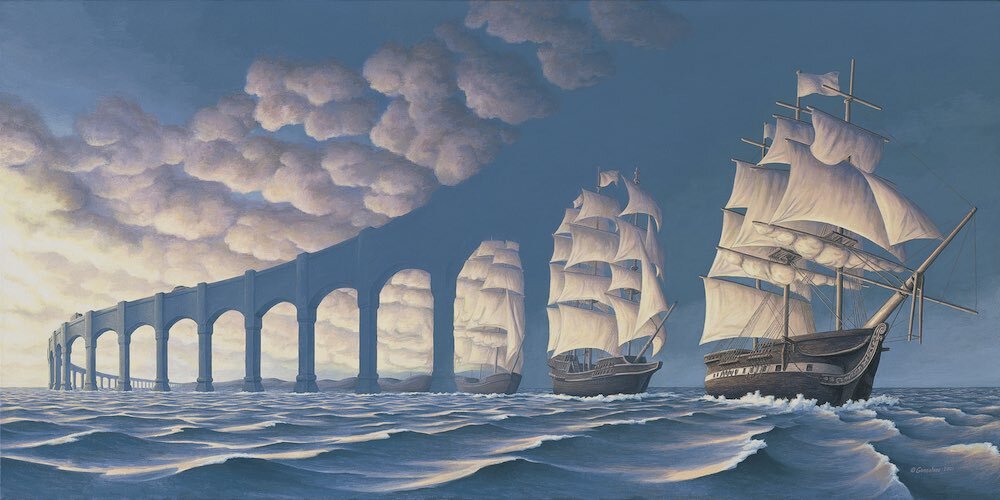
Let your eye travel from the stone to the sails. Find the place where its certainty changes.
Open a detail. Then let its surroundings back in.
The bright shape belongs to the sky. The dark structure around it carries the crossing.
Clouds gather the folds of canvas. An opening acquires a hull. Try to settle where one reading ends.
The bright shape is now cloth. The water is still water; the way of crossing it has changed.
The arch and the sail rhyme twice. First in form: a bright, rising shape against the blue. Then in purpose: each belongs to a way of crossing water.
That second rhyme is the opening for design. The scene can hold together even as our account of it changes. Stone gives way to cloth; the possibility of passage survives.
The tension lives in the middle. What counts as background in one reading becomes the thing itself in another. The frame makes a claim about what is there.
Start with the action two worlds can share. Here, it is crossing. Find the form that can belong convincingly to both. Then work on the difficult interval: how much surrounding evidence does each reading need?
Use the narrow frame to withhold that evidence. Widen it to find what makes a reading persuasive. Separate the fragments to inspect their independence; reunite them to inspect their continuity.
This is a reading of Gonsalves’s painting through the Windows Project. Its contours evolve across the canvas; they are not identical copies. The study changes their framing while the reproduction remains unchanged. What one viewer can connect here is a starting point for designing encounters between people who inhabit different frames.
From Carmen et Error: Manual for Navigating Multiplicity
The painting stays still while its reading turns. Arch and sail share a rhyme of form and purpose across one continuous sea.
Aspect-seeing offers a precise way to discuss the change: the image remains, while what becomes figure or background shifts.
This study introduces the design problem Windows develops: what can remain continuous while the surrounding interpretation changes?